
Matt Doll, Minnesota Environmental Partnership
In the state of Minnesota, you’re never more than a county or two away from a cattle farm. If you live in Stearns County, the state’s eighth-most populous, you certainly can’t miss them – only 20 counties in the entire US have greater dairy production.
If not beef or dairy cattle, there’s a good chance you live within 30-50 miles of a facility raising hogs, turkeys, or chickens, all of which are found throughout the state. You might notice the sight of barns and silos, the rumble of trucks bringing feed to the animals, or the smell of manure wafting over the landscape.
There are fewer such operations than there used to be, and the ones that remain are getting bigger. Former US Agriculture Secretary Sonny Purdue once caused a stir when he said of dairy farms, “(the) big get bigger and small go out.”
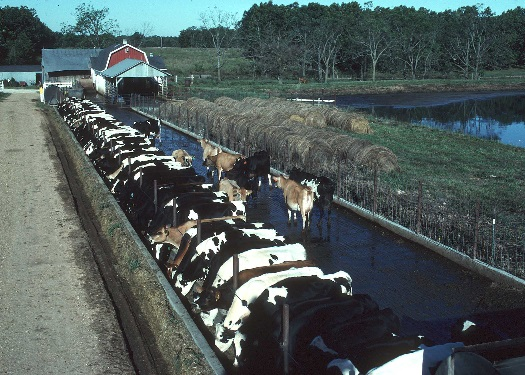
That’s certainly been the case in Minnesota, which was once home to over 150,000 farms with dairy cattle. Today, there are less than 2000, and the operations that remain are much, much larger. It’s a similar story with hogs and poultry. They largely aren’t being raised on open pastures on small farms, but on industrial-scale, concentrated feedlots.
Raising all these animals on feedlots produces a lot of meat and dairy to meet enormous U.S. and international demand. But it also produces manure, and lots of it – 48.9 million tons in 2024, according to research conducted by MEP member Environmental Working Group (EWG). That’s about 8.5 tons for every person in Minnesota.
All that concentrated manure has to go somewhere. Much of it is sprayed on farm fields very close to the feedlots, fertilizing crops like corn and soybeans with abundant nitrogen and phosphorus. But after the crops have had their fill, the excess ends up infiltrating the ground or washing into streams. These excess nutrients cause toxic algal blooms in lakes and downstream waters like the Gulf of Mexico, and nitrogen ends up in the groundwater as nitrate, where it can contribute to birth defects, cancers, and other diseases in those who drink it.
To make matters worse, more than 50% of the state’s feedlots are within a mile of vulnerable groundwater areas, places where it is especially easy for nitrate to infiltrate aquifers. The groundwater of the southeastern Driftless region is heavily contaminated due to a highly porous geology and a high concentration of feedlots and row crops that apply fertilizer. Various agencies, commissions, and organizations have been working on ways to solve the problem of manure impacts for decades, but Minnesota’s water situation has mostly gotten worse, not better.
Feedlot manure also has significant climate impacts. Manure generates gases including methane and nitrous oxide, both of which are greenhouse gases many times more powerful – though shorter-lived in the atmosphere – than carbon dioxide. Agriculture is responsible for 44% of the state’s methane emissions and 96% of its nitrous oxide emissions.
A chance to start solving this challenge
Fortunately, this year, the Minnesota Pollution Control Agency (MPCA) has created an opportunity to make significant changes to how feedlots are managed. For the first time in 25 years, the MPCA is proposing to update the animal feedlots rule, which sets baseline terms for animal feedlot permits in the state.
Changes to this rule could have a significant, positive environmental impact. For example, many of the state’s feedlots are operated so that their number of livestock falls just under the state’s requirement for a water pollution permit, which comes with increased oversight. Lowering that threshold could help reduce contamination in Minnesota’s waterways.
On a recent MEP-hosted webinar, member organizations EWG, Minnesota Center for Environmental Advocacy, and Land Stewardship Project outlined the rule and explained changes they hope to propose. In addition to lowering the threshold for a water pollution permit, these could include stricter limits on manure application in vulnerable areas, mandatory monitoring of fields where manure is sprayed to prevent runoff, and closing a loophole that allows an owner of multiple adjacent feedlots to treat them as separate for regulatory purposes.
Other MEP groups will propose changes to the rule, and we hope to see it updated and made much more effective by the MPCA. The good news is that the rulemaking process is still in its early stages, meaning that our voices can have a significant impact on the outcome.
We encourage any of our readers who drink water to comment on the rule or add your name to other organizations’ comments by July 22nd. If you have a or have special knowledge or interest in agriculture, water, or climate, you can tailor your message to reflect your perspective. This rulemaking is a rare and important opportunity to impact the state’s environment for years to come. If we want our waters manure-free and our climate healthy, we need to seize the moment.